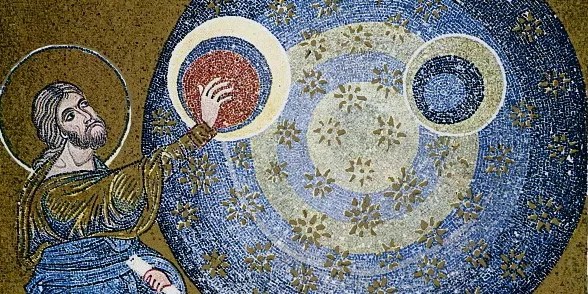
It has been said of the modern relationship between theology and science that the theologian interprets what the scientist finds. Where the cosmologist describes the expansion of the universe over a 13.7-billion-year period, or the biologist explains the evolution of creatures on earth, the theologian interprets this as the work of God in creation. In the case of Saint Thomas Aquinas, it could be said that this was in reverse. He interprets the story of creation as depicted in Genesis, with the aid of his contemporary science, philosophy; the scholastic field of theology.
The intellectual world in which Thomas worked was one of philosophical debate. Since the arrival of Aristotle in the West in the twelfth and thirteenth centuries, Christians were able to have an understanding of the natural world in relation to theology. Aristotle expressed the philosophical view that ‘from nothing, nothing comes’. Indeed, this view harkened back to even more ancient philosophies. Heraclitus, for example, stated that ‘this world order did none of the gods or men make, but it always was and is and shall be; an everlasting fire.’ Empedocles further said that ‘fools who fancy that that which formerly was not can come into being or that anything can perish and be utterly destroyed.’ Aristotle thus contended that ‘nothing can be said without qualification to come from nothing’. Thus, the medieval Aristotelian, of which there were many both before and during Thomas’ age, contended from this philosophy, that creation from nothing was absurd; and thus argued that the universe is eternal. However, this was at odds with the traditional and scriptural understanding of creation within the Christian framework; that ‘In the beginning God created heaven, and earth.’ Indeed before Thomas’ time many Christian theologians attempted to reconcile this philosophy to Christian theology and scripture, with the use of Hellenistic ideas. St. Augustine wrote that God is eternal and unchanging, but everything else is subject to change. St. Bonaventure expounded Augustine’s theory when he wrote ‘everything which has changed has in itself mutability; but every creature has been made; and so every creature has been changed therefore, none is immutable.’ Indeed in 1215, the Fourth Lateran Council declared the doctrine of creation; that the world was created ex nihilo by God, and that the world was not eternal, but temporal. Thus, by the age of Thomas, the building blocks had already been laid for an understanding of creation, and indeed work had already been done by Christian theologians. Thomas reviewed his predecessors work, looking at both Christian writers, but also the Hellenistic, Islamic, and Jewish worlds, and came to the conclusion that all creation traditions were mistaken in considering creation as change. He stated that ‘not only must we consider the emanation of some particular being from some particular cause, but also the emanation of all being from the universal cause which is God; and this emanation we designate by the name creation. Creation, which is the emanation of all being, is from the non-being which is nothing.’ This paper will first analyse the understanding and meaning of creation for Thomas, and then contend that creation ex nihilo is important for Aquinas on two fronts. Firstly, for understanding the nature of God, and secondly for understanding divine providence. That is; the framework within which God intervenes in His creation. This paper will contend that Thomas’ understanding that God is present in all things at every moment, enabling them to exist and to act, means that he is continually present in His creation through divine providence. This can be best understood by stating that all things only exist as a creation of God ex nihilo at every moment of their existence. All of creation finds God as both their efficient cause, the cause which causes them to be, but also their final cause, their end cause. Thus, all of creation is depend both in the beginning, but also continually on God for its existence.
The First Cause
First it is important to understand what is meant by creation ex nihilo for Thomas. He fundamentally believes that creation could be demonstrated purely philosophically; that is rationally. Whilst he uses Scripture as both the basis and defence of his arguments, Scripture is expounded by philosophy, to come to Thomas’ understanding and evidence of creation ex nihilo. Indeed, it could be argued that Thomas’ definition of creation is simply an exegesis of Genesis, interpreted through the lens of rational, Aristotelian philosophy. It is important to note the importance of the Christian context in which Thomas worked. Indeed, Aristotle, had no groundwork of Scripture to affirm to him creation; Aristotle had no doctrine of creation, believing that ‘being as being’, has no origin.
As mentioned, Thomas dismisses previous creation theories as processes of change. Indeed, he understands that all previous theories could not say anything of creation, because they presume the existence of matter.Thomas makes a distinction between creation and change; ‘creatio non est mutatio’. He states that creation accounts for the existence of all things, not for changes in things. ‘…it is necessary to say that also primary matter is created by the universal cause of things.’ What Thomas means is that created matter does not move – or indeed exist – unless it is first moved. He calls matter a passive principle, and therefore an effect of a first active principle. Creation ex nihilo is therefore necessary because it explains the permanency of God and implies that everything that exists has been created from absolute nothingness. Indeed, physical movements of matter are movements of change. If one speaks of the creation of matter in human terms; one really speaks of the transferring of matter and thus the creation of something from something else. Creation ex nihilo is important since it is the absolute creation of something from nothing. It is a process of metaphysical creation rather than one of physical change. Thomas states that to create in human terms, that is, ‘from, does not signify the material cause’.
In order to explain this, Thomas uses Aristotle’s philosophy of four causes; material, efficient, formal, and final. In using the word “cause”, both Thomas and Aristotle before him mean a factor that is responsible and explains something else. In explaining creation, Thomas talks of these four causes. That God is the efficient cause of everything except Himself, and created everything to exist by Himself, without mediation. ‘Since God is the efficient, the exemplar and the final cause of all things, and since primary matter is from Him, it follows that the first principle of all things is one in reality.’ This is a logical explanation of the idea that matter cannot be a principle, and that God is thus the only single source of all existence. However, Thomas also adheres to scripture; ‘I beseech you, my son, look upon heaven and earth, and all that is in them: and consider that God made them out of nothing, and mankind also.’ The closest scripture comes to a philosophical understanding in the way Thomas does is in Romans, ‘before God, whom he believe, who quickeneth the dead; and calleth those things that are not, as those that are.’ Thus, ‘creation is the production of something in its total substance of a thing, with nothing presupposed.’ Indeed, this is the basis of understanding creation; that if a human being creates something, he forms something from some other existing matter. However, logically this could be taken to the end of creation by God; that when God creates He creates the matter from which other things are formed. Indeed, it could be said that angels then used the matter created by God and put form into it. But God is not like the human being in the role of creator. Thomas says that when God creates, He brings something into existence and also that which received the existence. What he means by this is that both the matter and the form is created; instantaneously. It is only in these terms does divine providence make sense. That providence can only exist in a universe of matter and form; which is inside the realm of God’s timelessness. God cannot thus be limited by existence, for he is existence itself. So the first importance of creation ex nihilo is it that it lays the groundwork for divine providence. Indeed, divine providence is only possible if God is exterior to the confines of his creation. However, the more interesting question is why does divine providence happen, and how does Thomas understand this.
Given now that to create in the divine way is to make out of nothing that pre-exists, it is possible to see God as the First or Efficient Cause of everything that is. ‘Therefore, all beings apart from God are not their own being, but are beings by participation…caused by the First Being, who possesses being most perfectly.’ God thus is the primary cause of all matter to exist. To explain this Thomas states that matter is potentiality. Thus, for anything to exist it must have actuality and this can only be formed by God through creation of form with matter. Since matter cannot be without form, and since the form of something is created by God, so thus is matter. Creation, thus, is the very first making, it is the primary objective to creating things which can then go on to make other things.
The Final Cause
Christian theology holds that God is a creator who is both universally, but also intimately present in every aspect of His creation. Augustine commented before Thomas that God’s providence is evident in His moving of our will, working in us to do His good. However Thomas says that divine providence is both in the general sense, ‘the order of things foreordained towards and end; and the execution of this’. Thomas says that God can be understood as present in all things since ‘an agent is present to that upon which is works’ What he means by this is that God works intimately through all creation, through created causes, which he called secondary causes. Thomas sees this as a way by which divine power works; God wants to give all created creatures their own independence as causal agents. Thomas puts this well when he says that ‘it pertains to a king’s dignity to have ministers who execute his providence’ Indeed, this using of secondary causes in the work of divine providence does not diminish the power of God, since secondary causes are only ‘the executors of His orders.’
How does Thomas understand this? The only way to understand divine providence in the created world is first, as we have done, to examine creation ex nihilo, for it is this that carries with it the consequences of providence. Indeed, ‘in created things good is found not only as regards their substance, but also as regards their order towards an end and especially their last end, which, as was said above, is the divine goodness’. Thus for God to be the creator of the world ex nihilo, he must also be the creator who intervenes for all created things have an end that is towards God. This is for Thomas then, eternal and temporal divine providence. It is only after talking of the power and knowledge of God as creator that we can talk of His providence. Since God, as the final cause, directs things to an end, he must thus guide them by His providence. First one must understand the knowledge of God in all things. Thomas says that God must know all things since His knowledge is His being. God’s being is the source of all existence and His knowledge comprehends all other knowledge, and since His knowledge extends to everything, so too His providence must extend to everything. His knowledge is both of matter and form. This philosophy is based on Aristotle’s distinction between being and essence. The being, being the matter of something, such as a human being, and the essence, being the form of something, such as its idea; what a thing is, and the fact that it is. Since God produces both matter and form, God knows the matter of all things as well as the form of all things. In philosophy this would be the universal and the particular. Since he knows the individual he knows the mind of the individual the form, and the human of the individual as the universal. This is best explained by the understanding of divine prophecy of historical realities; best shown by the Old Testament prophecy in Isaiah 45:1 of Cyrus, the king of Persia. God thus knows universals, such as the created world, but He also knows particulars; our thoughts. Indeed, unless God knows our thoughts, that is the particulars of each individual created being, then there is no divine providence since He is not all knowledgeable.
Furthermore, divine providence is explained by Thomas’ expounding of Aristotle’s’ causes. Thomas states that all our actions still flow from God as the first cause. Indeed, only the falling short of this, sin, comes from us. Thomas says that ‘God is the cause of the act of sin: and yet He is not the cause of sin, because He does not cause the act to have a defect.’ Thomas, in Summa Contra Gentiles, understands divine providence in relation to scriptural references, ‘It is God Who works in us, both to will and to accomplish, according to His good will.’ He states that only by seeing God as the first cause can we say that only God can move the will, such as like Augustine described, since He is the cause both first and final, of all His creation, and can ‘move the will in the fashion of an agent’, that is from within. Thomas’ doctrine of creation is essential for understanding his view of divine providence. God’s divine action does not only involve original creation ex nihilo, but also the continuing creation. That is, the way in which God enables all things to exist and to act; and God’s guidance and action upon His creation. Thus, Thomas understands divine providence as the continual involvement of God in His creation, being the final cause.
Thus, the importance of Creation ex nihilo is how it relates to divine providence. Firstly, by stating that creation ex nihilo is the creation of all matter itself, and not from any presupposed matter, then it understands God to be exterior to the realm of the created world, and indeed outside the realm of matter. This is important because It allows a logical understanding of how God intervenes in the world. Secondly, by expounding Aristotle’s philosophy of the causes, Thomas understands God as both the first and the final cause, that ‘creation is the very dependency of created being upon its source.’ Since this dependency is continual and not simply ‘in the beginning’, it shows why God intervenes providentially.
How is divine providence understood by Thomas?
Given that Thomas understands the metaphysical aspect to how and why God divinely intervenes in His creation, it is important how this plays out in the physical reality. From his justification of creation ex nihilo, Thomas makes a distinction between primary and secondary causes, which might not as first seem apparent. The first creative and universal cause is God; but there are also secondary causes, which are agents which act in addition to their nature of being. That is, there is a difference between the way God causes as the creative cause, and the way other things, such as created things cause, as secondary cause. Nevertheless, it is important to note that all secondary causes are caused by the first, since the first is cause gives the secondary cause its being. In divine providence, God does not work directly in the world, but through secondary causes. Indeed, divine providence can be explained as manifestations of grace that occur in and through secondary causes. Thomas goes even so far to say that ‘chance and fortune’ are secondary causes through which God acts.With that being said, the ability of God, the primary cause, to achieve His will through divine providence, is dependent on the secondary cause. So, in divine providence, Thomas states that God acts, not directly, but through a chain of events of secondary causes, which He starts and thus guides. He gives divine actions to secondary causes which act within the natural order of the created universe. An example of this would be one person helping another person in distress, after being moved to concern by their will. Through this, God motivates the will of one secondary cause to help another person. One person is helped by another, but for Thomas, this action is ultimately caused by the primary cause, which is God. Indeed, this does not take away from the divine power of God. Thomas states that ‘secondary causes are not incompatible with providence; instead, they carry out the effect of providence.
Indeed, through this model of causes, Thomas can understand sin and the existence of evil in the world, in the light of divine providence. Evil is not caused by the direct actions of God, but rather because of the fragility of the secondary cause through which God works. Thomas states that ‘a secondary end depends on a principle one, just as a secondary agent depends on a principal one. Now, something wrong happens in the case of agent causes when a secondary agent departs from the order of the principal part.’
Free Will
In the Contra Gentiles, Thomas also addresses the issue of free will. From understanding divine providence in the world, it may seem that if God is the continual cause being fully present and active in His creation, then the free will of His creation is diminished. Indeed, Scripture states that ‘Whosoever are led by the Spirit of God, they are the sons of God, and ‘the charity of Christ presses us’. Indeed, it could be claimed that to be ‘led’ or pressed’ implies ‘coaction’. Coaction in this sense meaning that our will is joined to the will of God, thereby removing free will from human beings. However, Thomas states that this is not possible, since ‘man is ordered to his end by his will, for the object of the will is the good and the end.’ What Thomas means by this is that free will, by its nature, is directed towards God. Indeed, those people whose will does not direct towards God is not free, because it is enslaved to other wills, which a free will would never actually choose. Through this, Thomas can understand that all humans have a free will whose end is good. Thus, the real free will tends towards good and cooperates with God’s divine providence. It is only the will which is not really free which does not cooperate with divine providence. Indeed, Thomas in the Summa, says that those wills which are not free need God’s grace in order to be pointed towards God. ‘For the primary function of the gift of justifying grace is to order man to the good, which is the object of the will; and so man is moved towards this by a movement of the will, which is a movement of free choice.’
Miracles
Miracles are a concession to the divine providence. Whilst Thomas sees divine providence as God acting as the primary cause through secondary created causes, miracles are an exception, since in a miracle, God replaces the secondary created cause. Thomas defends the providence of God through miracles when he quotes Augustine, ‘God does on occasion do something against the usual pattern of nature.’ Indeed, Thomas builds upon this when he states that miracles must go beyond the usual pattern of observed nature, but goes on to say that miracles are not contrary to nature, since they happen in the nature of created things and that it is subject to God’s will. In the Summa Contra Gentiles, Thomas compares God who an artist who acts different on His work in different ways. Indeed ‘it is not, however, opposed to nature of an artefact that the artist should work in a different way on his product even after he has given it its first form. Nor therefore is it against nature that God should work otherwise in natural things that the customary course of nature operates.’ Since miracles seem contrary to our human understanding of nature, they only highlight the dependence of creation on the Creator, and the very notion that His creation is continually open to divine intervention. Indeed, it is the human experiences of miracles in which creation meets the hidden God. Thomas states that the ultimate end of divine providence is hidden from us, His creation, but Thomas points out that through miracles, God is active in His creation, throughout all of history and in all places. Indeed, fulfilling the revelation told to Moses; firstly that ‘I am who am’, showing that He is the cause of the existing of all things, and ‘I will show thee all good’, underlying the continual involvement of God through divine revelation.
History
Aside from philosophy, the importance of Thomas’ explanation of creation ex nihilo is a also a historic one; the rise of Neoplatonism. Aquinas knew of this phenomena, primarily through the works of his contemporary Avicenna. The Neoplatonist believed that the first being is not like any other being, because it is beyond other beings. From this one being comes all other beings, in a hierarchy from the one being, to the mind, to the soul, all the way down to the smallest creatures of the material world. The first things; the One being, mind and soul, are not part of the material world. Indeed, as the hierarchy develops the non-material become material, as it moves into the realm of matter. The question is, how is this bridge from non-material to material crossed. Platonism held that all things go back to One, which Thomas would agree with. What Thomas would disagree with is the hierarchical nature of Neoplatonism; that all things proceed chronologically from the One. Thomas would say that all of creation comes immediately from the One. The Neoplatonism held that the One was at the top of a hierarchy, but also in an ‘otherness’ from the rest of things. Indeed, for them, this being was unknowable, because it was the first of a series of steps and processes that ended up with the creation of the world. For Thomas, this being, or God, was ‘being itself’. Indeed,from this flows that God has a relationship, both knowable and real with His creation, because he is both being itself, and the cause of the being he creates in His creation.
Another of the problems of Neoplatonism was their understanding that only one can come from one. So the One being produces first the mind, and then the soul, and then all succeeding things down to the material creation. Furthermore, they believed that the first being creates by nature of itself. That is, through thinking it produces the soul and the mind, by having various thoughts intrinsic to itself as the primary being. Furthermore, this idea gives credence to the idea that the first being can only think of one thing at once. Thomas says firstly that their understanding of God is purely of nature and thus of the material world. Indeed, only nature produces single effects. When one plants a seed, it turns into a tree. But the creation of all trees, in all places, and instantaneously, is what God does. Indeed, God can do many things at once because He is not limited to the world of nature. Furthermore, Thomas states that God creates by free will, and not by ‘His nature’. Thomas states that ‘there remains to God a free judgement for willing either this or that, as there is also in us, and for this reason we must say that ‘free will’ is found in God.’ Thus, there is a historic importance to creation ex nihilo for Thomas; in order to combat contemporary theologies which, for Thomas, were mistaken and heretical.
Ultimately, Thomas aims to show that creation is only possible in the divine way ex nihilo, because any other understanding of creation would not have God as its primary cause. It is only through the acceptance of God as the efficient cause of all things to exist; as their first cause and continued cause, that Thomas can then go on to explain divine providence, by the way God continually involves Himself in His creation, thereby fulfilling the role of creator as the final cause. Indeed, the full dependence on God through creation ex nihilo therefore logically expands to the acceptance of God’s intervention in his creation. Creation ex nihilo is to create out of nothing; to be the cause, both primary and continual of all things that exist. If this is not held, then there could be things that are extant, and therefore not made by God. Logically it would follow that God is thus not the source of all existence. Thomas’ aim in understanding creation ex nihilo is ultimately to understand divine providence, as the means by which God is involved in His creation.
Bibliography
Aquinas, Thomas, Dei Potentia
Aquinas, Thomas, Questiones Disputatae de Veritate
Aquinas, Thomas, Summa Contra Gentiles
Aquinas, Thomas, Summa Theologiae
The Bible, Douay-Rheims 1899 American Edition
Boland, Vivian, Ideas in God According to Saint Thomas Aquinas: Sources and Synthesis (Leiden: Brill, 1996)
Bonaventure, Sentences
Brown, Montague, “Permanent Creation in Saint Thomas Aquinas” New Blackfriars, vol. 67 no. 795, 1986
Carroll, William E., “Cosmology and Creation” Logos, 15:1, 2012
Carroll, William E., “Creation and Science in the Middle Ages.” New Blackfriars, vol. 88 no. 1018, 2007
Copleson, F., A history of Philosophy, Volume II: Mediaeval Philosophy (New York: Doubleday, 1993)
Edwards, Denis, How God Acts: Creation, Redemption, and Special Divine Action (Minneapolis: Fortress Press, 2010)
Giberson, Karl W., Abraham’s Dice: Change and Providence in the Monotheistic Traditions (Oxford: Oxford University Press, 2016)
Hibbs, Thomas, Aquinas, Ethics and Philosophy of Religion: Metaphysics and Practice (Indiana: Indiana University Press, 2007)
Jensen, Alexander S., Divine Providence and Human Agency: Trinity, Creation, and Freedom (Abingdon: Routledge, 2016)
Mcgrath, Alister E., Christian Theology: An Introduction (Oxford: John Wiley & Sons, 2011)
Selman, Francis J., “Creation from Nothing.” New Blackfriars, vol. 83, no. 979, 2002

 Izaak Tanna
Leave a comment