In the contemporary world, one frequently hears the caricature of traditional Catholics, and those devoted to the Traditional Latin Mass, as little more than aesthetes. Their attachment to the Traditional Latin Mass is said to arise not from theology or doctrine, but from an indulgence in atmosphere. Incense, chant, vestments, and ceremony are invoked as evidence of a taste for theatrical excess, a nostalgic fondness for what is derided as ‘smells and bells’ from the pre-Vatican II era. The ancient liturgy, we are assured, survives by ornament alone. Yet, all these claims entirely collapse when we think of the essence of the Mass, made most evident and explicit in the Traditional Latin Mass, especially in the Low Mass, or the Missa lecta. It is only those who have the wrong theology of the Mass that believe the Traditional Latin Mass is extreme. The essence of the Mass is not the beautiful Gregorian chant that accompanies it, nor the meaningful rituals or dutiful ceremonies prescribed to it in its various forms, but the fact that everything points towards the Cross.
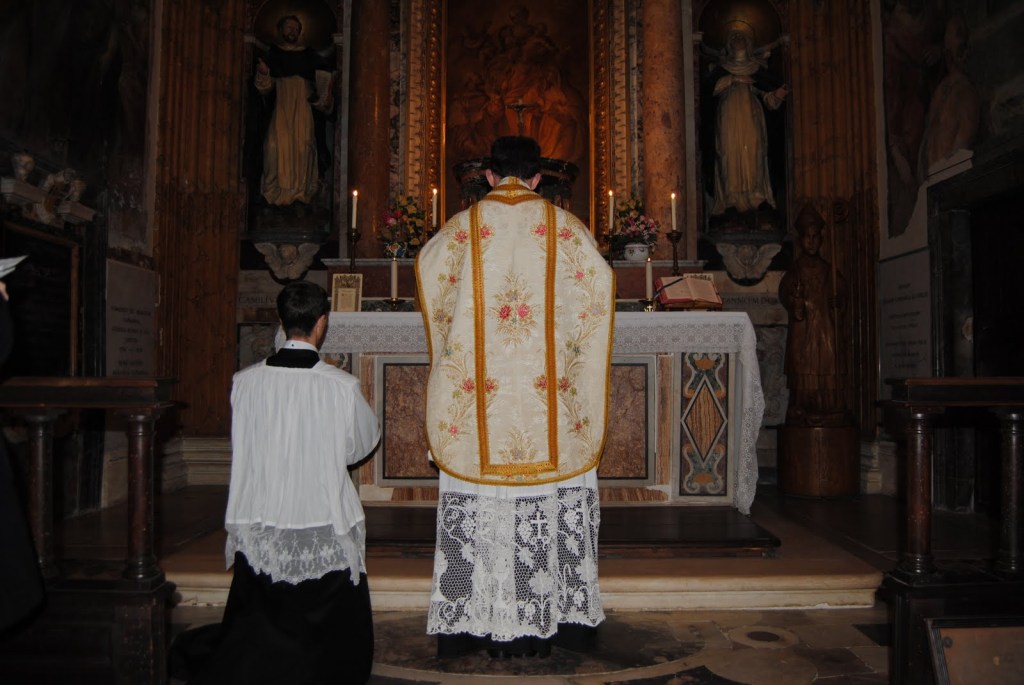
Historically the most common form of the Traditional Latin Mass, the Missa lecta is almost entirely stripped of the outward elements so often cited by its critics. The Low Mass is quiet, prayerful, with all eyes in adoration towards the Cross and altar. There is no incense, no choir, often even no homily. The priest prays in the sotto voce, the low quiet tone, standing at the altar facing God on behalf of the congregation. In the 30 minutes or so we are at Mass, we are transported both in mind, body and soul to the foot of the Cross so explicitly, that in this silence we are truly allowed and enabled to pray with the priest up to heaven. All distractions are removed. If we believe the claim that the Traditional Latin Mass is sustained by its aesthetic beauty and rituals, the Low Mass would be unexplainable.
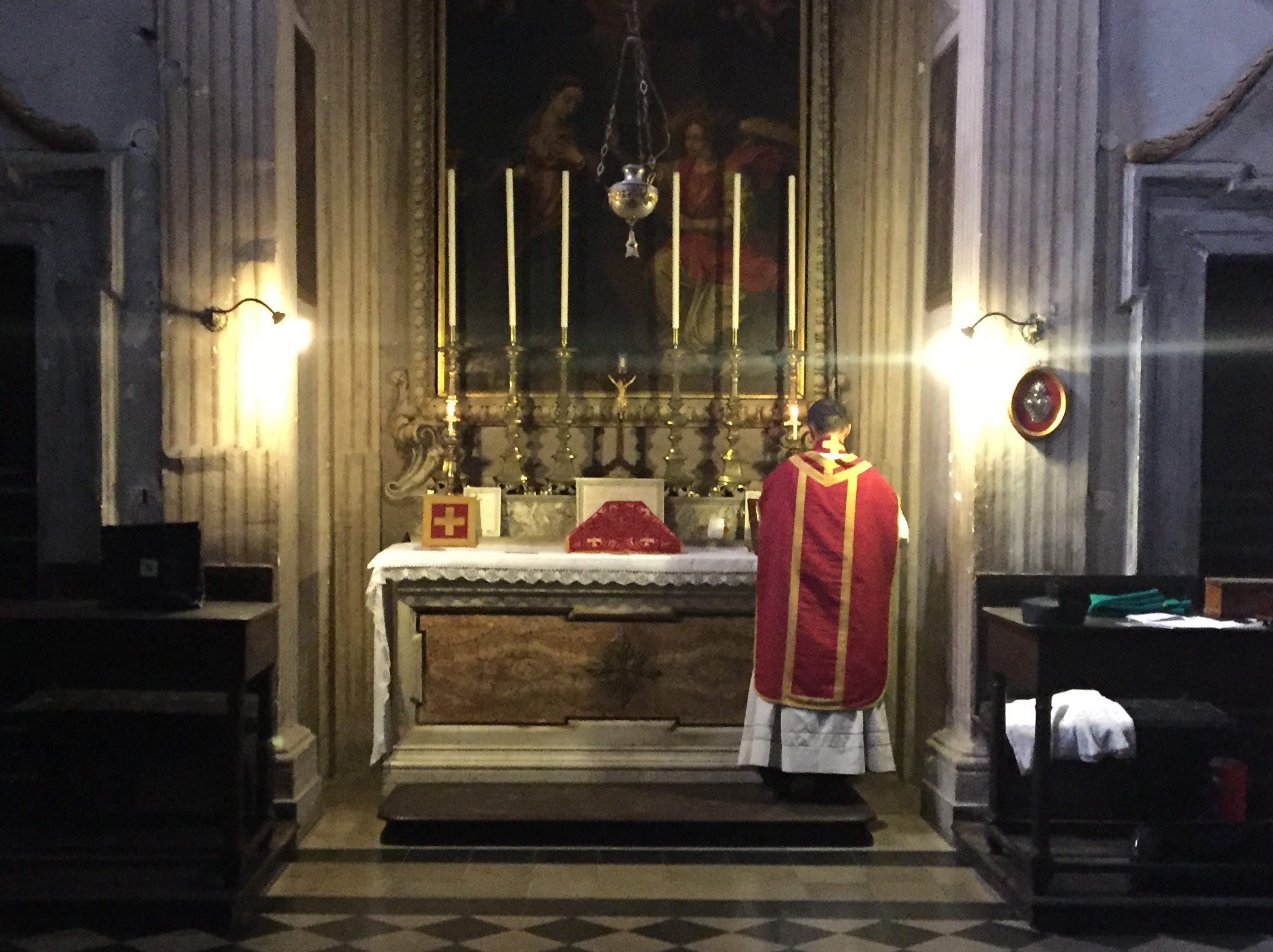
At its heart, the Mass is a sacrifice. The priest does not preside as a a social worker, a do-gooder, or leader of the community, nor perform as a public personality. He stands at the altar in persona Christi, offering anew, in an unbloody and timeless manner, the sacrifice of Calvary for the salvation of souls. This is not metaphorical language, but the plain teaching of the Church. As Saint John Chrysostom reminds us, the priest ‘fulfils a figure, while the power and the grace are of God’. The action taking place is divine in origin and effect, even as it is carried out through human hands. The true beauty of prayer, reverence and the reality of the sacrifice of the Mass made so evident, has nourished the world, the Church and the Saints for centuries. The silence that characterises the Roman Canon is therefore neither accidental nor exclusionary. It is theological. It declares that what is occurring exceeds human speech. In the Low Mass especially, silence becomes the proper language of reverence. The priest offers the sacrifice to God on behalf of the people, and the people are united to that offering not by verbal activity, but by intention, attention, and prayer. One is present not as an audience member, but as a worshipper.
We live in an age where participation is more important than prayer, and sound is more important than words. There must be constant activity, contemporary music, and visual aids. Contemporary prelates have often appealed to the attraction that the novus ordo allows ‘full and actual participation’ by the people. The Church Fathers knew better. Saint Augustine warned us that ‘much speaking is not the same as much praying’. Prayer, he insisted, is an interior act before it is an audible one. Saint Cyprian urged that prayer be offered with modesty and restraint, mindful that God hears the heart before He hears the voice.
The novus ordo is naturally predisposed to these vulgar and ugly ideas. Where we have endless congregational participation in the Liturgy of the Word followed by a shoddy, quick-time Liturgy of the Eucharist with Eucharistic Prayer 2. The meaning is reversed. Human beings take centre stage, and God is left as the after-thought. It seems almost impossible to a layman, if not for the authority of the Church, that Eucharistic Prayer 2 could have the same supernatural and spiritual dignity and value as the Roman Canon. I have had the privilege to serve at many TLM Low Masses. From Pontifical Low Masses celebrated by cardinals of the Church to 5am private masses in the quiet of Benedictine monasteries. The essence is always the same, the mass follows the same form, with changes only to the propers and readings for the day, feast or occasion. Forever the same, throughout the whole world each day. Unfortunately, in the novus ordo you are prone to find more variations in the same diocese, let alone in different countries. The genius of the Traditional Latin Mass, and of the Low Mass in particular, lies in its resistance to anthropocentrism. It does not ask what the congregation can bring to the liturgy, but directs attention to what God accomplishes. The danger of a relentlessly interactive liturgy is that human action comes to dominate the scene, while divine action is subtly marginalised. The Low Mass reverses this tendency. God is unmistakably at the centre, and man approaches Him with humility.
Much criticism is also directed at the use of Latin, which is said to obscure understanding and alienate the faithful. This objection betrays a narrow conception of comprehension. For centuries, Latin functioned as a sign and instrument of unity, enabling Catholics of every nation to worship with one voice. A Catholic could attend Mass in Rome, in Kenya, or in the Holy Land and recognise the same prayers, the same gestures, the same sacred orientation. I have experienced this in all three places! Habit breeds excellence, as Aristotle tells us. When we are familiar with the words of the Mass, those words lead us to heaven. Pope Pius XII described Latin as an effective safeguard against the corruption of doctrinal truth. Fixed liturgical language resists the pressures of fashion and ideology. The prayers of the Low Mass are not improvised, adapted, or shaped by personal preference unlike the improvisation of the novus ordo by the whims a priest or reader. They are received, preserved, and handed on. What is better, the unity and continuity of the Latin prayers, learnt by the faithful reverently, and repeated in their heart at every Mass – or, listening to an unknown rendition of the Roman Canon in one of its 13 complicated and totally different variations, and not knowing the familiarity nor beauty which God calls us to in these words? In the continuity of Latin, the faithful are not excluded, but elevated. The liturgy is lifted out of the realm of the everyday and secured within the Church’s living tradition.
From the Council of Trent to the present day, the Traditional Latin Mass has kept the unity of both the theological vision and the doctrinal soundness. The primacy of God is exemplified, and the sacrificial nature of the Mass is brought to the fore. Beauty is not primarily by sight or by sound, but by spirit. The visual and auditory are there as tools to raise up the soul. True beauty is found in a priest praying on behalf of his people, and the tradition of silence and contemplation, that speaks louder than words. The Low Mass invites the faithful into a deeper mode of participation, one that is interior, contemplative, and sacrificial. In its quiet, one is drawn to the foot of the Cross, where Christ’s Passion is made present upon the altar. Distraction is pared away. What remains is wonder, awe, and prayer. The Low Mass possesses none of the external splendour so often caricatured by its critics. And yet it continues to nourish faith, devotion, and sanctity. Its beauty lies not in what is added to it, but in what God does within it.
Further Reading
Augustine of Hippo, Letters, trans. Wilfrid Parsons, Catholic University of America Press.
Chrysostom, John, Homilies on Matthew, Nicene and Post Nicene Fathers, First Series.
Pius XII, Mediator Dei.
Council of Trent, Canons and Decrees, Session XXII.
Reid, Alcuin, The Organic Development of the Liturgy, Ignatius Press.
Fortescue, Adrian, The Mass: A Study of the Roman Liturgy, Longmans, Green and Co.

 Izaak Tanna
Leave a comment