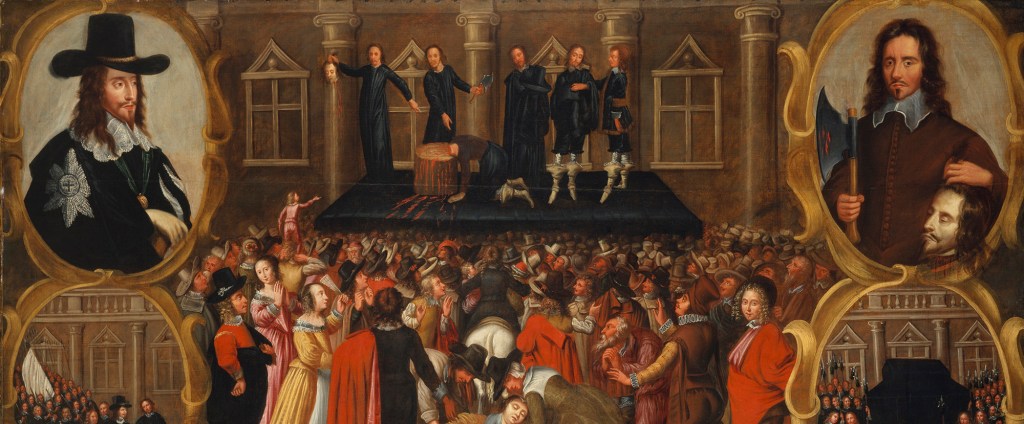
Since the days of Samuel Rawson Gardiner, history has portrayed Charles I of England as a man lacking in any visible virtue, be them kingly or otherwise. Hill named him a ‘petulant and obstinate king’. Morrill called him ‘incompetent’, Russell, ‘uncompromising’. Indeed, the historiography of Charles I; Whigs, Marxists, Revisionists and Post-Revisionists has been well documented. The overwhelming opinion is of a king who was ‘stupid, lazy, arrogant, deceitful and authoritarian. A king whose iniquities and actions ultimately led him to his own execution on that fateful day in January 1649.’ Historians have found Charles as the great exacerbator without whom civil war would have been ‘impossible to imagine.’ In Past and Present, Mark Kishlanksy offers a worthy repudiation of the centuries of historiographical uniformity. He specifically combats the attacks against Charles’s character; those charges of reclusiveness, of absolutism, and uncompromise. In dealing with where responsibility lies for the execution of the king, one must examine the personal character of Charles, which determined his actions, and indeed his downfall. This even more so for a man whose overarching virtue was a sense of duty, his obligations as a king to govern his subjects according to his own infallible ideal. Could Charles’s own personal character be the cause of his death? Or is it that he was unsuited to the time he found himself in? Kishlanksy concludes by suggesting that all the conflicts between Charles and his people resulted from fear. Be it fear of the king’s religious tendencies and predispositions, or in his willingness to rule without parliament in his authoritarian fashion. This essay will examine the claim that fear was at the heart of Charles’s opponents. To what extent was the fear founded from their opinions of Charles as a man, be it in the realm of kingly authority, or his belief about his position as the head of the Church.? There are, then, two lines of inquiry; kingship and religion. This essay will examine both in order to see if they lay at the root of the execution of the king.
Kingship
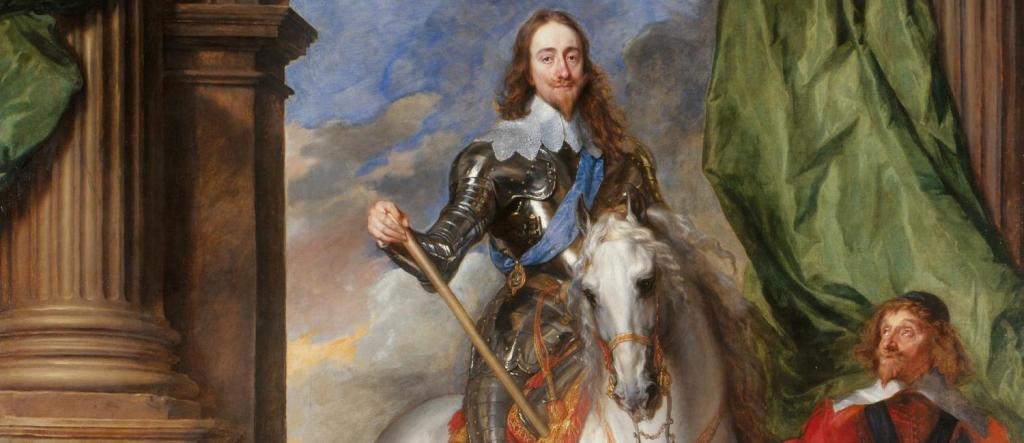
Kenyon writes that Charles had no qualities of kingship, that he was ill-equipped and never ‘enjoyed the act of ruling’ as both his father or his sons did; that he fulfilled his duties of kingship with ‘petulant distaste’. This seems a mistaken claim for a prince who was brought up in the glory of majesty, taught from an early age by tutor and clergyman alike that he was God’s chosen ruler, and who saw his role as paternal father to his people. The nature of this kingship was a particularly early modern and Stuart definition of the Divine Right of Kings. That authority was derived directly from God, and not from the people. This was engraved in the whole rule of Charles and directed his motives and actions. Indeed, as he said to parliament in 1628, ’I owe the account of my actions to God alone.’ Charles carried, like his father James I before him, this doctrine of divine right all his earthly life. The only difference between father and son is that the son was called to discharge his belief, to death.
Charles’s personal rule of 11 years from 1629 to 1640 was not tyrannical since Parliament was not part of the daily regime of government. Indeed, James I preferred not to rule with a parliament, bar the times he needed to raise funds. Historians who therefore refer to this period as the ‘Eleven Years Tyranny’ or the ‘autocratic rule’ can be dismissed as exaggeration. During this time, he exhibited his kingly virtues by gaining support from those outside London. He won support at many levels of society, mainly, as Hughes points out, from fear that a widespread Puritan religious reformation could create. Indeed, it was not that Charles ruled without counsel, but rather through the institutions of personal government, the Privy Council. Whilst it could be said he overstepped the mark in using his prerogative powers during this period, such as the Ship Money taxation, it could also be argued that the king used his Royal Prerogative in a time of crisis. It should be noted that when John Hampden refused to pay the Ship Money and brought a court hearing, it was the king who allowed the case to come to law. Furthermore, Hampden’s lawyer denied the king’s authority to act in an emergency, nor to define what formed crises. Evidence of the crisis, and the just actions of the king, is that the money was not paid to Charles, but kept apart from other revenues. It was not paid into the Exchequer, but to the Treasury of the Navy, which was then used for its intended purpose. Here we see the proper execution of his executive power rather than the historical narrative of tyrannical abuse of power in taxation.
One of the incidents which is often used as a precursor on the path of the scaffold is that of the attempted arrest of the Five Members in the House of Commons. It must be remembered that this incident was preceded by numerous provocations from Parliament, least of all the Grand Remonstrance of 1642, which intended to show the abuse put upon the people through the king. Furthermore, there was increasing dissent by members of the Commons, least among them John Pym, who was baying for blood against. Then Parliament arrested twelve protesting bishops in the House of Lords and levelled impeachment upon them. This deprived Charles of twelve of his own votes in the Lords. On the 3rd January Charles sent the Attorney-General first to the Lords and then to the Commons to arrest six members in total – five from the Commons – on charges of treason. It should be noted that this legal procedure and impeachment was the same mechanism that the Commons had taken a few days earlier against the twelve bishops. Historians including Gardiner contend that Charles had a good legal case for arresting the men for treason. However, the stir and suspicion this caused could have been avoided by ‘seizing them in their beds.’ Charles’ use of power here is put in proportion to the time, place and precedence.
In combatting the claim of Charles being uncompromising, there is evidence of him discharging his duty as king above that of friend, as in the case of the earl of Stafford, one of his closest advisors. In his execution he appeased parliament and gained their support for his dealings in Scotland. Whilst this was a saddening ordeal for Charles, he considered both the public mood, who roared their approval when the axe fell, as well as parliament’s mood found in the Act of Attainder. Charles, knowing full well Strafford was to be executed, sent a letter on 11 May 1641 in person with the Prince of Wales exclaiming ’mercy’ as ’inherent and inseparable to the king as justice’. An informed and just dealing with both the mood and temper of the country and parliament. In these examples, Charles shows his kingly virtue in different ways. What could be said is that Parliament was losing its sense of deference towards the Lords and the monarchy. This gaining power caused a fear of monarchical rule, which has existed for centuries prior. Charles showed himself as a king of old. Indeed, a king who would go to the scaffold rather than betray his Church, laws and rights, can only be called an uncompromising and principled king. Having spoken of kingship, the next realm of inquiry is that, as Julian Davies coins, “sacramental kingship”, or the religious disposition and policies of Charles.
Religion
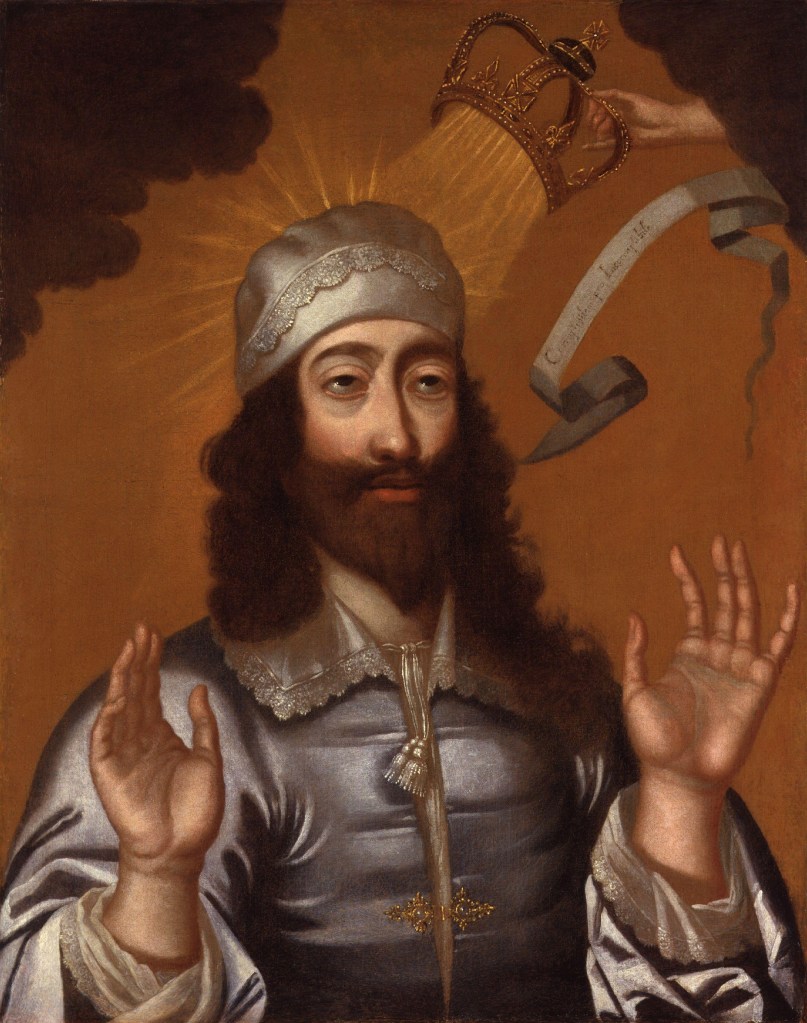
As a young man, writing to Pope Gregory XV in 1623 Charles made clear that the differences he sees between Catholicism and Anglicanism are of an unhappy, and sorry disposition. Indeed, he vowed to build the bond of unity to His Holiness, indeed endeavouring to strive with all “labours and vigilance”. It could be said that these early encounters with the Roman Church set the tone, if not in title, then in both liturgical form and depth of piety. Charles was not a Catholic, but he was Catholic minded. He believed in the Roman ideal that the head of the Church should be singular, and reign supreme. Indeed, he disavowed himself to the populist impulses of both the Reformation, and more importantly of evangelical Puritanism. The diminishing virtue of deference was in the religious and well as political realms. Calvinism, for instance, emphasised the equality in worthlessness of ’prince or pauper’ alike. As Clarendon points out the civil war of the seventeenth-century provided the platform for ordinary people to participate in radical political movements.
William Laud, in his preaching at the beginning of Charles’s reign reminded people that the ‘king is God’s immediate lieutenant upon earth’ and that ‘God and the king stand very near together’. It should be remembered that the Church was a political as well as a religious organisation, and this has significant repercussions in the temporal as well as the spiritual world of the seventeenth century. Laud, was a politician as well as Charles’s archbishop, as Gardiner comments, acting ’as if he had been the King’s secretary.’ His liturgical reforms can be summed up in the phrase ’the Beauty of Holiness’. A rejection of Calvinism as well as Puritanism and religious diversity, in favour of a ’Romanisation’ of the liturgical worship of the Church of England with the king as the head of the Church. But also, it should be noted, a rejection of the religious plurality that was maintained under James I. One of the attractions of Laudianism was the principle of indisputable authority and the ceremonies which exhibited this authority. Within his three kingdoms religious diversity only increased and, as in the Roman principle, Charles believed that in ecclesiastical matters he should consult only a limited number of close confidants whom he trusted. Charles put his money where his mouth was, and endowed a number of Oxford scholarships to train ministers in the doctrine and discipline of the Church of England. As the king and Laud sought to solidify their changes, the more it became necessary for each side to prove that they did not belong to the other. It could be posited that the two opposing camps were the democratic Puritans against the sacred majesty at the head of the Church of England. Laud recognised that Puritans were also subversive to the state. In refusing to obey the Church, he thought, they ultimately undermined the state and king. But was this insistence on uniformity throughout the kingdoms to blame for Charles’s ultimate downfall? Many historians point to the very fact of the civil war as evidence of is.
Religious diversity in all the kingdoms of Charles were on the whole opposed and fearful, to the reforms of Laud in the Anglican Church, of Charles’s belief in the supreme head of the Church. It could be said that the diversity in parliament exacerbated this problem. For instance, Pym was vehemently against Catholicism being tolerated in Ireland, yet also one of Charles’s biggest problems. Russell lays the blame of the beginning of the troubles at Charles’s decision to impose the Scottish Prayer Book, but the House of Commons opposition to Irish rebellion was far worse than Charles’s actions in Scotland regarding the prayer book. There was a crisis in the multiple kingdoms, and Charles was caught in the middle of this, for simply upholding the constitution and lawful religion of his kingdoms. This crisis of religion was also a crisis of authority. This crisis and division made powerful men nervous, anxious and fearful. Charles was the pawn caught in the middle of strongly held beliefs held by religious sects who would have seemed foreign and subversive. What united these religious sects in the kingdoms was their fear of Charles’s religious predispositions. Scots and English opponents of the king were united against his Arminianism and popery. This was the cause of the Charles’s downfall, both of his personal rule due to breakdown in negotiations in Scotland, and his departure from London in 1642.
Before concluding, it is important to note the actual situation in January 1649. Following the end of the civil wars, Parliament still had the energy to negotiate with Charles. Cromwell, and those wanting to bring the king to trail then forcibly expelled MPs sympathetic to Charles; an operation known as Pride’s Purge of December 1648. Clement Walker, one of those MPs purged noted of the Rump which convicted Charles to death, ‘a parliament of corrupt maggots in it.’ This purge removed any legitimacy or authority left in Parliament, and there was no doubt now that Cromwell and the army were the judges of Charles. The Rump and the army worked in cahoots to bring about Charles’s execution. The illegitimacy of the trial is further evidenced by the fact that many of the men on the High Court of Justice did not even attend the proceedings. It would be fair to contend that Charles’s verdict was a forgone conclusion. The declaration of revolution was given on 4th of January 1649, and outcome of the trial was central and essential to preserving this constitutional revolution. Indeed, had the outcome been any different Cromwell himself said that he would have had to flee the country. Charles himself knew this, and thus refused to give them what they craved. He saw himself, rather as the defender of the people against a tyranny, and it is not had to see why.
Conclusion
In his personal rule of Charles, one can see his attempts to both follow his ideal and principles, but pragmatically impost a greater order at all levels of his kingdoms. In contrast to his father, he was able to live frugally, at the same time as holding a court society known for its elegance. He tried to enforce unity and uniformity but found himself in a world. where more people had great power and influence. Charles was not a politician and as Kevin Sharpe tells us, it is wrong to judge Charles by the standards of a modern politician. He was a fallible man of infallible principles, and this the cause of his downfall. He held on to ancient beliefs in an ever-changing and ‘modernising world’. He might have failed to judge the shifting sands below him, but that was because they were changing ever so fast. His character, as we have seen, was the cause of actions and events which exacerbated the ever-changing nature of politics and religion in the seventeenth-century. But can this be a cause of the execution of the king? No, but rather irrational fear by his powerful, urban, opponents. Russell concludes that the character of Charles was chiefly to blame for the civil war, concluding his execution. Rather, the trial and execution of Charles was one of the many battles in a rapidly changing constitutional crisis in England. Though the king had been killed in January 1649, the war proceeded on.
Bibliography
Burgess, Glenn, Absolute Monarchy and the Stuart Constitution (Yale: Yale University Press, 1996)
Cressy, David, “The Blindness of Charles I.” Huntington Library Quarterly, vol. 78, no. 4, University of Pennsylvania Press, 2015, pp. 637–656
Gregg, Pauline, King Charles I (California: University of California Press, 1984)
Harris, Tim, Rebellion: Britain’s first Stuart Kings, 1567-1642 (Oxford: Oxford University Press, 2015)
Hill, Christopher, The Century of Revolution, 1603–1714 (Abingdon: Taylor and Hill, 2014)
Holmes, Clive. “The Trial and Execution of Charles I.” The Historical Journal, vol. 53, no. 2, Cambridge University Press, 2010
Holmes, Clive, Why was Charles I Executed? (London: Bloomsbury Academic, 2006)
Howell, T. B., A Complete Collection of State Trials and Proceedings for High Treason and Other Crimes and Misdemeanours from the Earliest Period to the Year 1783, Volume 3 of 42 (London: T.C. Hansard, 1816)
Hughes, Amy, The Causes of the English Civil War (Basingstoke: Palgrave, 1998)
Kenyon, J. P., The Stuarts: A Study in English Kingship (London: Severn House, 1958)
Kelsey, Sean. “The Trial of Charles I.” The English Historical Review, vol. 118, no. 477, Oxford University Press, 2003, pp. 583–616
Kesselring, K. J., The Trial of Charles I: A History in Documents (Peterborough: Broadview Press, 2016)
Kishlanksy, Mark, A Monarchy Transformed 1603-1714 (London: Penguin Book)
Kishlanksy, Mark, ‘Charles I: A Case of Mistaken Identity’, Past and Present, 189 (2005)
Lee, Maurice, The Road to Revolution: Scotland under Charles I, 1625-37 (Urbana: University of Illinois Press, 1985)
McElligott, Jason, Royalism, Print and Censorship in Revolutionary England (Woodbridge: Boydell Press, 2007)
Morrill, John, The Nature of the English Revolution (London: Routledge, 1994), pp. 41-81
Richardson, R. C., The Debate on the English Revolution, Third Edition (Manchester: Manchester University Press, 1998)
Russell, Russell, The Causes of the English Civil War (Oxford: Clarendon Press, 1990)
Seel, Graham E., & Smith, David L., The Early Stuart Kings, 1603-1642 (Abingdon: Routledge, 2005)
Sharpe, Kevin, The Personal Rule of Charles I (Yale: Yale University Press, 1992)
Young, Michael B., Charles I (Basingstoke: Macmillan Press, 1997)
Worden, Blair, The Rump Parliament 1648-53 (Cambridge: Cambridge University Press, 1977)
The Letters Speeches and Proclamations of King Charles I, ed. Charles Petrie (London: Cassell, 1935)
Seventeenth-century England: A Changing Culture, Volume 1: Primary Sources, ed. Ann Hughes (London: Open University Press, 1998)

 Izaak Tanna
Leave a comment