
In the age of Thomas Aquinas, the establishment of the mendicant orders was still a recent development in the history of the Church. Indeed, both older orders and conservative clergymen looked down on the Dominicans with distain. On the one hand the contemplative orders saw the mendicant, begging orders as a scandal to the Church, for working with their hands, and on the other hand the active secular clergy saw them as trespassers into their parishes. Indeed, it could be said that the mendicant orders blurred the distinctions between the contemplative and active religious lives.[1] Aquinas, in his opus devotes much time to the contemplatives and the active life – particularly in the Summa Theologiae – in order to both realise and defend his very own mendicant, Dominican vocation. Indeed, an understanding of Aquinas’s positions on the contemplative life can only be understood through the lens of his Dominican calling. Aquinas spent his active life in the urban city as a writer, teacher, administrator and preacher. However, in theory there ought to have been many reasons why Aquinas did not become a Dominican. For instance, his early life and upbringing was as a Benedictine, where he later declined the Abbacy of Monte Cassino. For he joined the somewhat newly founded Dominicans at the age of about nineteen, against family pressures for him to join the Benedictines.[2]
Here, I will analyse Aquinas’s thoughts on the contemplative and the active life, which can be otherwise understood as ‘love of God’ and ‘love of neighbour’. Aquinas uses the terms contemplative life and the active life to understand different types of life, as shown in II.II.179, but he also uses this distinction to understand different types of religious institutions, as in II.II.188.6. I will focus on Aquinas’s discussion of the contemplative and actives lives in II.179-182, and how they are both initiated by charity, towards happiness as shown in I.II.3.[3] In the Summa, Aquinas first contends that ‘the contemplative life in itself is more excellent than the active,’[4] but then asks, ‘Is a religious order devoted to the contemplative life better than one devoted to the works of the active life?’ He then goes on to respond by saying that part of the active life is teaching and preaching, which ‘flows from the fullness of contemplation; and that ‘this is better than mere contemplation’.[5] Mary Catherine Sommers suggests that Aquinas changed his understanding and altered his reasoning on the matter from Secunda secundae to Tertia pars.[6] Indeed, this is a possibility since Aquinas is noted for changing his mind on the role of the Holy Spirit in the contemplative and active lives. However, I contend, as Rik van Nieuwenhove does, that Aquinas’s thinking on this matter does not radically change, and that his notions of the perfection of the contemplative life and the necessity of a particular active life (‘the high rating among religious orders must be awarded to those which are geared to teaching and preaching.’)[7] are consist throughout his life, from his decision to join the Dominicans in the 1240s to his writing the Summa twenty years later.[8]
Love of God
‘…simplex intuitus veritatis.’[9]
Contemplation in the philosophical understanding, for example Platonic or Aristotelian, can mean an intellectual view of the truth, greater than reasoning, and accompanied by admiration, as Aquinas says, ‘the simple consideration of truth.’[10] Aquinas understands the contemplative life as an intellectual activity of the mind, which ‘consists in love’ and ‘terminates in delight’. He states that ‘as regards the very essence of its activity, the contemplative life belongs to the intellect; but as regards that which moves one to the exercise of that activity, it belongs to the will, which moves all the other faculties, and even the intellect, to their acts.’[11] Thus, for one to engage in the contemplative life, it requires the will to pursue the contemplation, which is in itself an act of the intellect. Contemplation flows from a love towards God and which ends in a deepening love and connection with God.[12] However, this contemplation can be both of a natural, but also a supernatural form. Indeed, in his commentary on Isaiah, Aquinas makes a distinction between the contemplation of the lives of the saints, and the contemplation of God.[13] However, Aquinas is chiefly concerned with the contemplation of eternal things, namely truth, which consists in ‘love of God’.[14] For Aquinas this contemplative is the mystical vision of God, which for Aquinas is mankind’s truest happiness, but which will only be fully realised in the world to come.
‘Man’s ultimate happiness consists in the contemplation of truth, for this operation is specific to man and is shared with no other animals. Also, it is not directed to any other end since the contemplation of truth is sought for its own sake. In addition, in this operation man is united to higher beings since this is the only human operation that is carried our both by God and by the separate substances (angels).[15]
While this vision of God will only be realised in the world to come, there is an imperfect vision on earth, what Aquinas calls felicitas, an imperfect happiness. This vision can be realised through contemplation. The act of contemplation for Aquinas is both a means and an end in itself, indeed it is not simply and act, but a way of life. It is both the way to happiness, but also happiness itself.[16] The happiness of the individual is the last end, since it is man’s supreme good. Thus all created creatures are called to happiness by participation in God, who ‘is happiness by His Essence.’[17] Perfect happiness cannot be attained in this life, since only in heaven will man’s mind be united to God, ‘by one, continual, everlasting operation.’[18] Indeed, for Aquinas, since happiness is the uniting of the mind, and thus the contemplation of God with the Essence of God, it must stand that Aquinas can from this determine the contemplative life as leading to the greatest happiness in this life. He states that ‘the active life, which is busy with many things, has less happiness than the contemplative life, which is busied with one thing, exempli gratia, the contemplation of truth.’[19] Happiness consists solely in the contemplation of Divine things, which brings him closest to ‘God and the angels, to whom he is made like by happiness.’
But how does one partake in contemplation. To this, Aquinas points out four particular things that ‘pertain, in a certain order, to the contemplative life; first, the moral virtues, secondly, other acts exclusive of contemplation; thirdly, contemplation of the divine effects; fourthly, the completion of all, which is the contemplation of the divine truth itself.’[20] The first two of these of these are needed for the life of contemplation, and are therefore preparations; being properly disposed morally and intellectually for communion with God, and partaking in certain mental exercises which are not themselves contemplative but preparations. The third and fourth constituents are considerations on God itself, which is the contemplative act.[21] While contemplation is indeed an act of the intellect and the mind, it is true to say that the contemplative life for Aquinas requires the whole person in the discipline.[22] Indeed, it is the love for contemplation, driven by the love for God which moves the intellect to contemplate. Therefore, when the contemplative life is attained, it is pure joy.[23] For Aquinas contemplation is centred around divine truth, which is the end of all human life.[24] Indeed, all other forms of knowledge are ordered towards this end. He states that ‘therefore the last and perfect happiness, which we await in the life to come, consists entirely in contemplation.’[25]
There are nine reasons that Aquinas gives for why the contemplative life has precedence over the active; as befitting the most excellent things in humanity, as being more continuous, as bringing greater delight, as being more self-sufficient, as loved more for itself, as consisting in leisure and rest, as concerned with higher or greater things, as more proper or distinctly human and as Christ himself commends Mary over Martha in Scripture.[26] It is clear that in Aquinas’s comparison of the two lives he draws heavily on Aristotle. Indeed, eight of these are taken directly from book 10, chapter 7 of Aristotle’s Nicomachean Ethics. Indeed, each text from the Ethics is compared with a biblical or patristic text by Aquinas. It might seem evident from a reading of Aquinas’ nine arguments, eight of them based on Aristotle, may have settled the matter that the contemplative life is most definitely greater than the active. Indeed, as Sommers points out, the addition of a scriptural ninth argument is not used to justify the matter, but simply to complete with a gospel agreement with an already reasoned argument.[27]Whilst Aquinas agrees with Aristotle’s book 10 in seeing the contemplative life above the active life, he nuances this when speaking of vocations to religious orders. He says that all religious orders are instituted for the sake of charity; charity which includes both the love of God but also love of neighbour. Aquinas states that ‘charity is the good which we desire for all those whom we love out of charity’s sake.’[28] Thus, we desire unity with God for those whom we love. He follows Augustine when he states that we should love our bodies out of charity.[29] This it could be contended that for Aquinas, we love our neighbour because we love God. That is, our love for God inspires us to love our neighbour. Indeed, he states that, ‘since man loves his neighbour, out of charity, for God’s sake, the more he loves God, the more does he put his enmities aside and show love towards his neighbour.’[30] From this we can see how the contemplative life compels us to lead an active life. Whilst the contemplative life seeks to speak time with God alone, the active life seeks to serve the needs of fellow man.[31] Indeed, when speaking like this, it is perhaps obvious that he thought to imitate after the motto of his own Dominican order; contemplate aliis tradere.
Thus, in the Third Part of the Summa, Aquinas confirms this reasoning rather than going back on it, commenting that ‘as it is said in the Second Part, the contemplative life is unconditionally better than the active which concerns itself with bodily acts; but the active life in which someone gives to others the products of contemplation through preaching and teaching is more perfect than the life which is devoted solely to contemplation, because such a life presupposes an abundance of contemplation.’[32]
Love of Neighbour
Indeed, in writing this, he harkens back to his earlier writings in the Summa.
‘…the active life is necessary for any degree of the love of neighbour. Hence Gregory says that ‘Without the contemplative life is it possible to enter the heavenly kingdom, provided one omit not the good actions we are able to do but we cannot enter therein without the active life, if we neglect to do the good we can do.’ From this is it evident that the active precedes the contemplative life, as that to which is common to all precedes in order of generation, that which is proper to the perfect.’[33]
This seems to be in contradiction with his prior notion that the best way to love God is through contemplation. However, he goes on to qualify what he means when he says this. Indeed, this passage could be a warning to those who would enter the contemplative life in haste, without giving proper consideration to the active life.[34] Furthermore, Aquinas suggests that the active life is the key to salvation, rather than the contemplative. He says that a person ‘merits more by the works of the active life.’[35] What Aquinas explains is that whilst it is true that the contemplative life is superior to the active life, the active life is a better life for the Christian. Despite the nine arguments given in II.II.I82.a.I, Aquinas understands that in some circumstances, most evident the very reality of the human life, the active life should sometimes prevail.[36] This reality of life is evident when he reflects on the ‘needs of the present’[37] and the ‘necessities of the present life.’[38] Aquinas thus understands the needs of the world in its fallen nature, and sees the role of the active life in bringing people to God. He states that the urgency of charity moves the contemplative person to perform works of the active life. Indeed, in these cases, ‘when a person is called from the contemplative to the active life, this is not done by way of subtraction but by way of addition.’[39] Furthermore, works in the active life, such as preaching and teaching of the Christian truth, require by THE very reason of their nature – that is truth – contemplation. Aquinas makes it clear that salvation and fulfilment for mankind is found chiefly in the love of God and neighbour. In this life, though, that charism must take precedence, even over contemplation. Thus, it is appropriate for man to be concerned with works of charity and with preaching and with study, so long as it works for the salvation of souls.[40] Indeed, whilst our love for God ontologically precedes and flows to one’s neighbour, it is the encounter with our neighbour that gives us the real and concrete way to love God.[41]
For Aquinas, ultimately the true contemplative life is not achievable in this life, since its goal is the fulfilment of unity with God, which will only come in the next. He asserts this when he says that ‘in a qualified sense or in a special case, the active life is to be preferred, in view of the needs of the present life.’[42] But it is important to note that Aquinas thinks that the active life can also lead to happiness. Indeed, he thinks that both the contemplative, but also the active can lead to imperfect happiness; active imperfect happiness and contemplative imperfect happiness.[43] In the Nicomachean Ethics Aristotle poses two kinds of happiness. Firstly, one consisting in pure contemplation and a second in happiness consisting in the exercise of wisdom and moral virtue. However in the Eudemian Ethics, he gives a single kind of happiness which includes both contemplative and active elements, which can be best understood as a combination of ‘contemplation and service’. It is interesting to note that Aquinas probably did not have knowledge, at least first-hand, of Aristotle’s Eudemian Ethics however, his notion of the active and contemplative life seeking to practice the ‘service of God’ is much closer to it, than to the Nicomachean Ethics.[44]
Thus, Aquinas acknowledges that the active life is superior to the contemplative when material necessities of the human existence demand it, but also when, through charity, the contemplative is moved to perform works of the active life. Indeed, he states that ‘the aspect under which our neighbour is to be loved is God, since what we ought to love in our neighbour is that he may be in God. Hence it is clear that it is specifically the same act whereby we love god, and whereby we love our neighbour. Consequently, the habit of charity extends not only to the love of God, but also to the love of neighbour.[45]
Dominican Vocation
In the early Dominican book, the Lives of the Brethren, Master Jordan is asked ‘What Rule do you follow? And he replied ‘The Rule of the Friars Preachers. And this is their Rule: to live an upright life, to learn and to teach.’[46] Aquinas stated that ‘it is a greater thing to hand on to others what has been contemplated than merely to contemplate.’[47] This, it could be said, is the essence of Aquinas’s Dominican vocation. Indeed, handing on the fruits of contemplation is essential to the Dominican way of life. Furthermore, this is the life which Christ himself chose.[48]
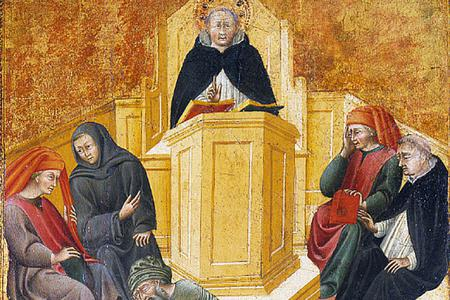
It could be understood that the works of the Dominican vocation are particular to Aquinas’ understanding of the superior active life. Works of mercy in the world, such as corporal works of mercy are done out of a love of neighbour, which flows from love of God, but they do not intrinsically require contemplation. However, the Dominican charism of preaching and teaching; specifically, on Christian truth, requires a certain amount of contemplation, for the subject matter of their active work is truth, which Aquinas states is the aim of contemplation. Teaching is done through speaking and instructing, and these are both outward signs of internal concepts. Thus, the object of teaching is a matter which is an internal conception. Aquinas is able to state that the active life devoted to teaching is better than the purely contemplative life. [49] It is important to note that a distinction does exist. When someone conceives some truth internally with a view to that truth directing their external action, then this is of the active life. But when a person internally considers a truth where they contemplate on it purely for its own delight, and then is compelled to share this truth with others out of charity, then this is of the contemplative life.[50] Aquinas understands two different kinds of active lives. The first being entirely in external actions such as alms giving, but the other consists in teaching and preaching. In preaching and teaching, the religious person draws on the fruits of previous contemplation; passing on to other the truths thus learned. Indeed, for Aquinas, ‘just as it is better to light up others than to shine alone, it is better to share the fruits of one’s contemplation with others than to contemplate in solitude.’[51] Here Aquinas refers to the preacher of the Gospel and the teacher of doctrine. Indeed, it is clear from this that Aquinas joined the Dominicans since he saw them as the closest to the life of Christ, who is ‘the most excellent of teachers.’[52] In the charism of study, Aquinas employs a similar reasoning. He says that the distinction between the active and contemplative is unique to mankind, since man is concerned about the things studied. Indeed, concern for the needs of the present life pertains to the active life, but studies ordered to the reflection of truth pertain to contemplation, since contemplation is part of the intellect since it is concerned with truth.[53]
It is clear that Aquinas favoured a balance of the two lives and found this perfection in the Dominican vocation. Indeed, he stated that the contemplative life was in itself of greater merit, but that some external works may be of greater merit, since the active life comes ‘in the way of fruitfulness and with regard to us.’[54] Indeed, the love given to God by religious men and women can be channelled through the contemplative and the active life; ‘according to the activity of the active life and of the contemplative.’[55] Indeed, as well as the purely contemplative orders of monks and hermits, there should be active contemplatives where action forms part of their life which are the preachers and other religious orders, for whom with the approval of Church authorities could teach and preach for the salvation of souls. Aquinas was evidently thinking of the mendicants when writings this, whose work was approved by Pope Alexander IV who commented that ‘the Lord, whilst Martha was serving and working, especially commended Mary’s listening, attention and study of his word.’[56] Both ways of life, the active and contemplative, are found in the teacher, since a good teacher is concerned primarily with truth, and the end act of the teacher is the good of the pupil. Thus, whilst teaching belongs to the active life, it requires a commitment to the contemplative in order for it to be good.[57] The Dominican life can be best described as noted by Brian Davies, of ‘contemplative activity.’[58] Aquinas states that ‘the contemplative life is, absolutely speaking, more perfect that the active life which is taken up with bodily actions; but the active life according to which a man, by preaching and teaching, gives to others the fruits of his contemplation is more perfect than the life by which a man contemplates alone.’[59]
It is evident to me that Aquinas’s opinions on the superiority of the contemplative and active Dominican vocation did not change from his decision to join in the 1240s, to his writings twenty years later. Indeed, his very decision to join the Dominicans over the easier route to the Benedictines shows a conscious, if not fully realised, understanding of the nature of the Dominican vocation. This is further evidenced in the Sentences, when Aquinas states that ‘there are a number of operations which require both, such as preaching and teaching; which, originating in contemplation, end in action, as moving from cause to effect.’ Thus, it is evident that Aquinas’s thoughts are consistent from his early career; that whilst the cause should always be contemplation, the effects show themselves in action.[60]
Conclusion
Aquinas’s understanding of contemplation is one which first argues for the superiority of the contemplative life, but then grants that out of love, which is Charity, one should turn to action in this life, where it is necessary, and indeed more meritorious than remaining in contemplation. He does not definitely see the contemplative life as the best way to love God, nor does he think that leaving the active life to pursue the contemplative life is the highest calling, especially when the contemplative life is devoid and exempt of love of neighbour.[61] He points out, however, that the best active life is one in which it flows out of contemplation, which can be best understood as the Dominican charism of preaching and teaching, which flows out as the fruits of contemplation. Indeed, this identification, of the superiority of the contemplative life, but bringing this contemplation into the world for the sake of humanity, firmly makes him an apologist for the mendicant orders, as opposed to the secular priests or the monastics.[62] He thus advocates for a mixed contemplative and active life. He himself would not use this term since this would remove the distinction between the characteristics of both.[63] Hence the Dominican vocation is potior, since it links together both lives, and both loves; that is the love of God and the love of neighbour. He says that we love both God and fellow man in the ‘same act’ and thus there is a unity between the two loves.[64] The end of contemplation is in the life to come where mankind will see the blessed vision of God. Indeed, this end will only be revealed in the state of glory, whilst in this world mankind can only see it when glory breaks into it. Aquinas calls the contemplative life in itself superior because it prepares us for a life with God. Indeed, he recognises the primacy of it in earthly existence, but defends the Dominican charism for the salvation of souls so that a great number of souls may one day be in eternal contemplative union with God, which is our ultimate end.
[1] Anthony Kenny, ‘Aquinas on Aristotelian Happiness’ in Scott Charles MacDonald & Eleonore Stump (eds.), Aquinas’s Moral Theory (Ithaca: Cornell University Press, 1998), pp. 25-26
[2] Brian Davies, ‘St Thomas Aquinas as a Dominican’ in New Blackfriars Vol. 60, No. 706 (March 1979), p. 104
[3] Summa Introduction xix
[4] II.II.182.a.1
[5] Brian Davies, The Thought of Thomas Aquinas (Oxford: Clarendon Press, 1992), p. 4
[6] Mary Catherine Sommers, ‘Contemplation and Action in Aristotle and Aquinas’ in Gilles Emery & Matthew Levering (eds.), Aristotle in Aquinas’s Theology (Oxford: Oxford University Press, 2015)
[7] II.II.188.6
[8] Rik van Nieuwenhove, ‘The Relation between the Active and Contemplative Lives according to Thomas Aquinas’, in The Thomist: A Speculative Quarterly Review, Vol. 81. No. 1. (2017), pp.1-30
[9] II.II.180.a.3
[10] Reginald Garrigou-Lagrange, Christian Perfection and Contemplation (London: Herder Book Co., 1958), p. 221
[11] II.II.180.1
[12] Manfred Svensson & David Van Drunen, Aquinas Among the Protestants (Oxford: John Wiley & Sons, 2017), p. 197
[13] Bernard McGinn, The Harvest of Mysticism in Medieval Germany (1300-1500) (New York: Herder & Herder, 2005), p. 31
[14] II.II.180.a.1
[15] Summa Contra Gentiles III.27
[16] Mary Catherine Sommers, ‘Contemplation and Action in Aristotle and Aquinas’ in Gilles Emery & Matthew Levering (eds.), Aristotle in Aquinas’s Theology (Oxford: Oxford University Press, 2015), p. 167
[17] I.II.3.1
[18] I.II.3.2
[19] I.II.3.2
[20] II.II.180.4,a.1
[21] Manfred Svensson & David Van Drunen, Aquinas Among the Protestants (Oxford: John Wiley & Sons, 2017), p. 204
[22] II.II.180.a.1
[23] IIa.IIae.180.a.7
[24] II.II.180.a.4
[25] I.II.3.5
[26] II.II.182.1
[27] Mary Catherine Sommers, ‘Contemplation and Action in Aristotle and Aquinas’ in Gilles Emery & Matthew Levering (eds.), Aristotle in Aquinas’s Theology (Oxford: Oxford University Press, 2015), p. 173
[28] II.II.25.2
[29] II.II.25.5
[30] II.II.25.8
[31] IIaIIae.188.2
[32] III.40.a.1.ad.2
[33] II.II.182.4.ad.1
[34] Gerald J. Beyer, ‘The Love of God and Neighbour according to Aquinas: An Interpretation’ in New Blackfriars Vol. 84, No. 985 (March 2003), p. 126
[35] II.II.182.2
[36] Bernard McGinn, The Harvest of Mysticism in Medieval Germany (1300-1500) (New York: Herder & Herder, 2005), p. 36
[37] II.II.182.1
[38] II.II.182.ad.3
[39] II.II.182.1.ad.3
[40] Vivian Boland, St Thomas Aquinas (London: A&C Black, 2014), p. 206
[41] Gerald J. Beyer, ‘The Love of God and Neighbour according to Aquinas: An Interpretation’ in New Blackfriars Vol. 84, No. 985 (March 2003), p. 120
[42] II.II.182.1
[43] I.II.5.a.4 & II.II.180.a.2
[44] Anthony Kenny, ‘Aquinas on Aristotelian Happiness’ in Scott Charles MacDonald & Eleonore Stump (eds.), Aquinas’s Moral Theory (Ithaca: Cornell University Press, 1998), pp. 25-27
[45] II.II.25.1
[46] Brian Davies, ‘St Thomas Aquinas as a Dominican’ in New Blackfriars Vol. 60, No. 706 (March 1979), p. 103
[47] II.II.188.a.6
[48] III.40.1.ad.2
[49] Stephen J. Pope, The Ethics of Aquinas (Washington D.C.,: GUP, 2002), p. 347
[50] Vivian Boland, St Thomas Aquinas (London: A&C Black, 2014), p. 205
[51] IIaIIae.188.6
[52] Vivian Boland, St Thomas Aquinas (London: A&C Black, 2014), p. 206
[53] Vivian Boland, St Thomas Aquinas (London: A&C Black, 2014), p. 204
[54] II.II.182.1
[55] From Contra impugnantes Dei cultum et religionem, 1 and 4, Giles Constable, Three Studies in the Medieval Religious and Social Thought (Cambridge: Cambridge University Press, 1998), p. 112
[56] Giles Constable, Three Studies in the Medieval Religious and Social Thought (Cambridge: Cambridge Unviersity Press, 1998), p. 112
[57] T. Brian Mooney, Understanding Teaching and Learning (Luton: Andrews UK Limited, 2011), p. 210
[58] Brian Davies, ‘St Thomas Aquinas as a Dominican’ in New Blackfriars Vol. 60, No. 706 (March 1979), p. 103
[59] III.40.1
[60] Rik van Nieuwenhove, ‘The Relation between the Active and Contemplative Lives according to Thomas Aquinas’, in The Thomist: A Speculative Quarterly Review, Vol. 81. No. 1. (2017), p. 7
[61] Gerald J. Beyer, ‘The Love of God and Neighbour according to Aquinas: An Interpretation’ in New Blackfriars Vol. 84, No. 985 (March 2003), p. 127
[62] Bernard McGinn, The Harvest of Mysticism in Medieval Germany (1300-1500) (New York: Herder & Herder, 2005), p. 36
[63] Rik van Nieuwenhove, ‘The Relation between the Active and Contemplative Lives according to Thomas Aquinas’, in The Thomist: A Speculative Quarterly Review, Vol. 81. No. 1. (2017), p. 7
[64] Gerald J. Beyer, ‘The Love of God and Neighbour according to Aquinas: An Interpretation’ in New Blackfriars Vol. 84, No. 985 (March 2003), p. 117

 Izaak Tanna
Leave a comment